
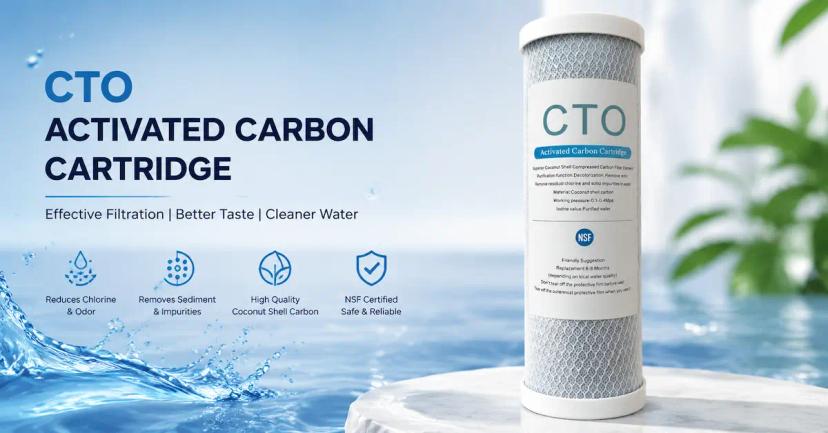
A water filter works because of its cartridges
No matter how beautiful the housing or how many features it has, a water filter is useless without good cartridges.
Filter cartridges are the heart of a water filter. Just like an engine for a car or a CPU for a computer.
There are many types of water filters on the market, but regardless of brand or model, the cartridges inside are essentially the same few types. The differences lie in materials, fill volume, and combination methods.
This article explains the most common types of filter cartridges. After reading, you will understand what each cartridge does and how to choose the right configuration for your customers' needs.
Introduction:
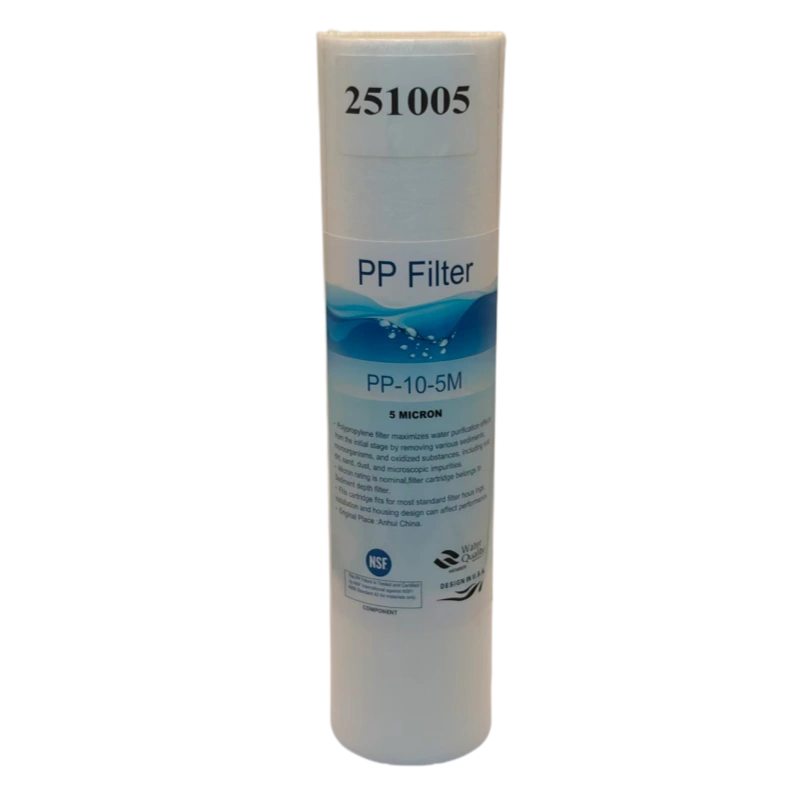
Type 1: PP Sediment Filter
A PP sediment filter is made of polypropylene fibers that are wound or melt-blown together. It looks like a roll of white cotton.
Its function is physical filtration – trapping large particles such as sand, rust, and suspended solids. Think of it as a very fine sieve: water passes through, but dirt does not.
The PP filter does not remove chlorine, heavy metals, or bacteria. It only handles large particles and serves as the first stage in most water filters, protecting the downstream cartridges from clogging.
Replacement cycle is typically 3-6 months, depending on the raw water quality. The poorer the water quality, the more frequent the replacement.
Our PP sediment filter is NSF certified, with material safety and structural integrity verified by an authoritative third-party organization.
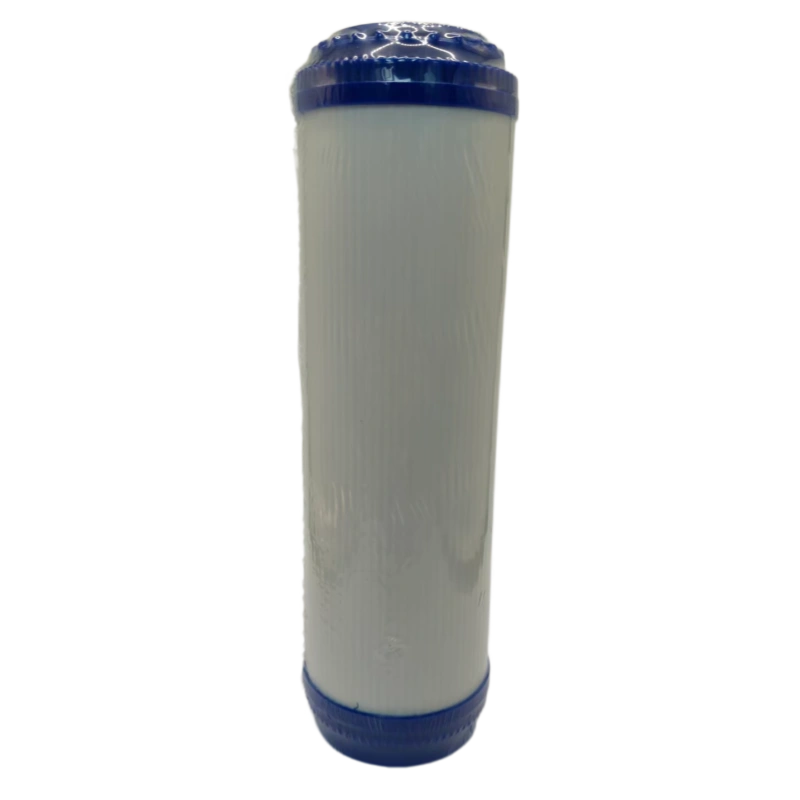
Type 2: GAC Filter (Granular Activated Carbon)
GAC stands for Granular Activated Carbon. It is made by crushing and screening coconut shell carbon or coal-based carbon into irregular granules.
The function of a GAC filter is adsorption. As water flows through the gaps between the granules, it comes into full contact with the activated carbon surface, adsorbing chlorine, off-flavors, odors, and some organic compounds.
One characteristic of GAC filters is low flow resistance and high flow rate, making them suitable as the second stage or pre-treatment stage of a water filter. Their fast adsorption speed effectively improves water taste and smell.
Replacement cycle is typically 6-12 months, depending on water quality and usage volume.
Our GAC filter uses high-quality coconut shell carbon with an iodine value of 1,000mg/g or higher. Additionally, our GAC filter is NSF certified, with material safety and adsorption performance supported by authoritative test reports.
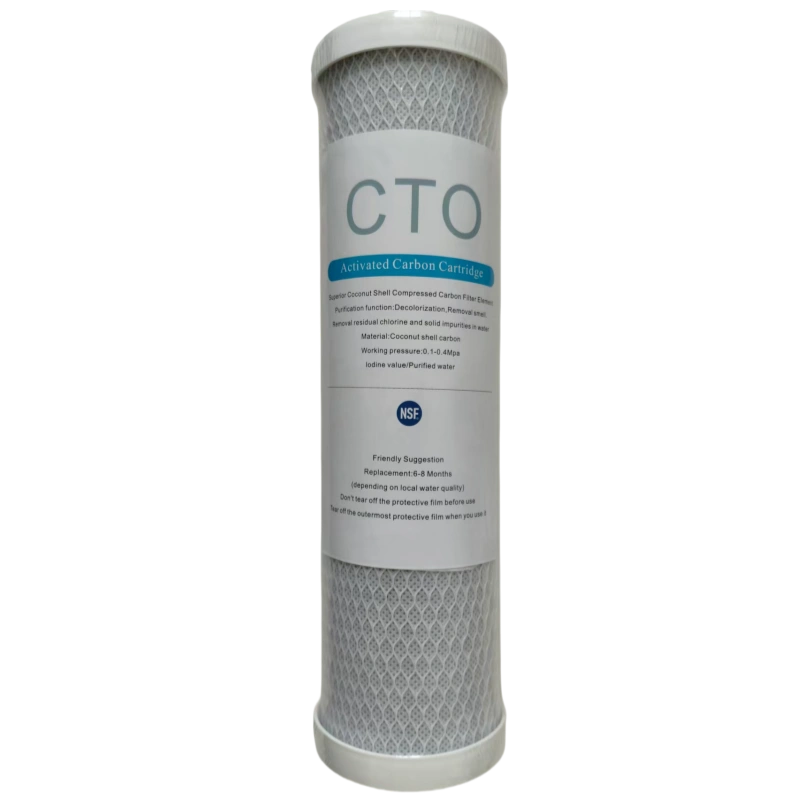
Type 3: Carbon Block Filter (CTO)
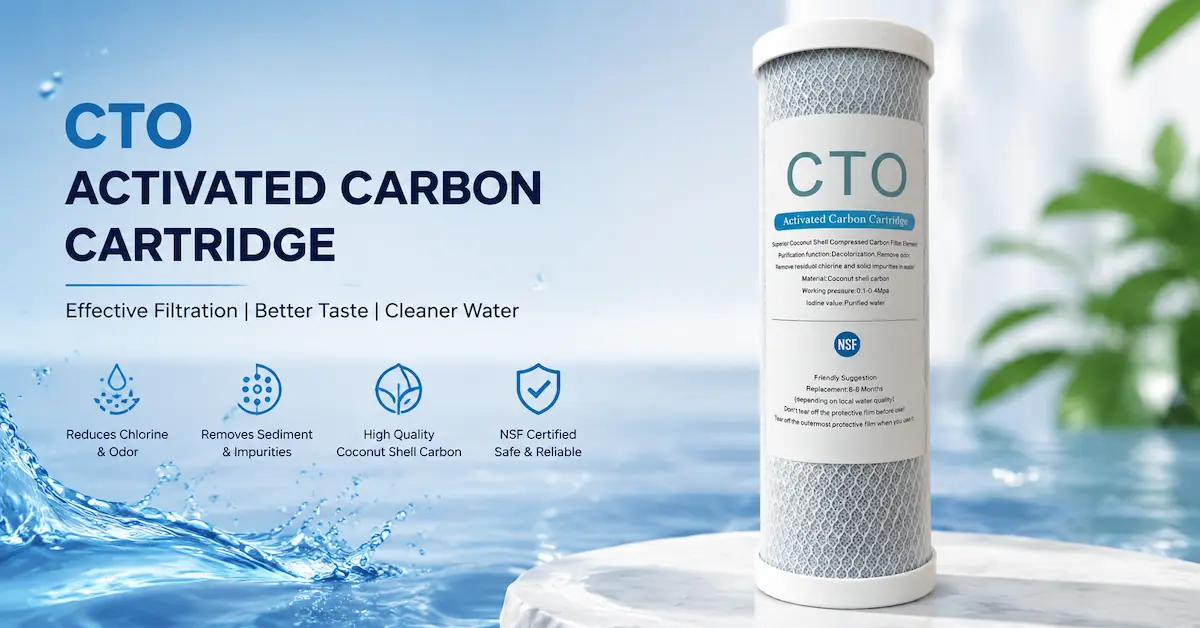
A carbon block filter (commonly referred to as CTO) is made by mixing activated carbon powder or granules with a binder and extruding them under high temperature. It is denser than GAC and takes the form of a hard, rigid block.
Due to its denser structure, a CTO filter has higher filtration precision than GAC. It not only adsorbs chlorine and odors but also traps some fine particles. As water flows through, it must pass through the micro-channels inside the carbon block, resulting in more thorough adsorption and more complete filtration.
Replacement cycle is typically 6-12 months.
Our CTO filter also uses coconut shell carbon with an iodine value of 1,000mg/g or higher and is NSF certified.
Relationship Between GAC and Carbon Block
Both GAC and CTO are activated carbon filters, but they differ in form and function.
| Type | Form | Characteristics | Application |
|---|---|---|---|
| GAC | Granular | Low flow resistance, fast adsorption | Pre-treatment, protects downstream filters |
| CTO | Block | High filtration precision, thorough adsorption | Fine filtration, improves taste |
They are often used together. GAC is placed first for rapid chlorine adsorption, while CTO follows for further fine filtration, collectively protecting the downstream RO membrane.
Type 4: RO Membrane (Reverse Osmosis Membrane)
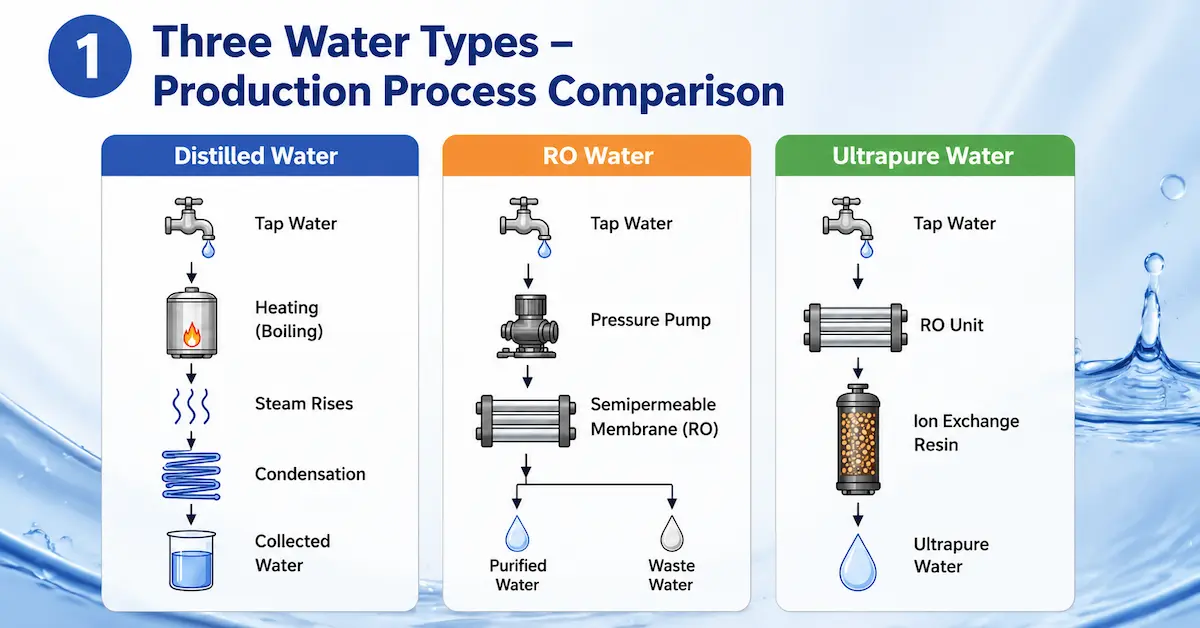
The pore size of an RO membrane is 0.0001 microns. For comparison: a human hair is about 50 microns in diameter. In other words, the RO membrane pore size is one five-hundred-thousandth of a human hair.
This extremely fine pore size enables RO membranes to achieve the most thorough filtration. They can remove heavy metals (lead, mercury, arsenic, etc.), bacteria and viruses, scale (calcium and magnesium), nitrates and fluorides, and the vast majority of dissolved solids. Water from an RO membrane is close to pure water.
RO membranes do not retain minerals. If a customer wants to "retain minerals," then an RO membrane is not the right choice. However, the amount of minerals humans get from water is very small – most come from food.
The RO membrane is the most expensive cartridge in a water filter, but it also lasts the longest. Replacement cycle is typically 1-3 years.
Our RO membrane is NSF certified, with filtration performance (including rejection rate, heavy metal removal rate, etc.) and material safety supported by authoritative test reports.
Type 5: Ultrafiltration Membrane (UF Membrane)
The pore size of a UF membrane is larger than that of an RO membrane, approximately 0.01 microns – 100 times larger than RO, but still much smaller than activated carbon pores.
UF membranes can remove bacteria and large organic molecules, but they do not remove scale or dissolved solids.
The advantages are that they do not require electricity and produce no wastewater. The disadvantage is that they cannot remove scale or heavy metals.
Replacement cycle is typically 12-24 months.
UF water filters are suitable for areas with good water quality where bacteria are the main concern, but not for areas with hard water (since they cannot remove scale).
Type 6: Resin Softening Cartridge
A resin softening cartridge contains ion exchange resin. The resin surface has sodium ions that exchange with calcium and magnesium ions in the water, thereby removing scale.
The resin softening cartridge does one thing: it softens water by removing calcium and magnesium. It does not remove chlorine, bacteria, or heavy metals.
After the resin becomes saturated, it needs to be regenerated with salt. Most small household softeners do not have a regeneration function, so the cartridge must be replaced once saturated.
This cartridge is primarily used in water softeners or as pre-treatment for RO systems to protect the RO membrane.
Common Filter Cartridge Combinations
Once you understand the function of each cartridge, different combinations can address different water quality issues.
Basic Configuration: PP + Activated Carbon (GAC or CTO)
This combination removes rust, sediment, chlorine, and odors, but does not remove scale, heavy metals, or bacteria. Suitable for areas with good water quality or for users who simply want to improve taste.
Standard RO Configuration: PP + GAC + CTO + RO Membrane + Post Carbon
PP traps large particles, GAC rapidly adsorbs chlorine, CTO provides further fine filtration, the RO membrane removes heavy metals and bacteria, and the post-carbon improves the taste of the outgoing water. This combination addresses virtually all common water quality issues. Suitable for most households, especially those with unknown or poor water quality.
UF Configuration: PP + Activated Carbon + UF Membrane
This combination removes rust, sediment, chlorine, odors, and bacteria, but does not remove scale or heavy metals. Suitable for areas with good water quality, no scale issues, and where bacteria are the main concern.
Key Indicators of Cartridge Quality
For B2B buyers, several dimensions are worth considering when evaluating cartridge quality.
Filter material is the most fundamental. Is the activated carbon coconut shell or coal-based? Is the GAC particle size uniform? Is the CTO density sufficient? Which membrane supplier is used for the RO membrane? These directly determine filtration performance.
Fill volume is equally important. Two cartridges that look identical may have a fill volume difference of nearly half, resulting in a significant difference in service life. It is recommended to specify fill volume requirements when purchasing.
Certification is another important reference. Our PP sediment filter, GAC filter, CTO filter, and RO membrane are all NSF certified. For B2B customers who value product quality, this is a tangible advantage.
About Our Cartridges
As a professional home water filter manufacturer, we have several commitments when it comes to cartridges.
First, all four core cartridges are NSF certified. Our PP sediment filter, GAC filter, CTO filter, and RO membrane all have authoritative third-party verification. This is rare in the industry.
Second, we use only coconut shell carbon for our activated carbon cartridges. No coal-based carbon, no mixing. The higher cost is justified by better performance and longer life.
Third, we strictly follow design specifications for fill volume. No cutting corners, ensuring every cartridge has a substantial amount of filtration media.
Fourth, whole-system certification is also available. Several series of our water filters have passed whole-system NSF certification. If you need a whole-system certified solution, we already have products available.
Fifth, we support OEM and ODM services. You can purchase our complete filters or buy cartridges separately. You can put your own brand on them or have them customized to your specifications.
Conclusion
Filter cartridges are the core of a water filter. Choose the right cartridges, and the quality of the complete filter is assured.
We do not make the cheapest cartridges. We make cartridges that are made with solid materials, have comprehensive certifications, and give our customers peace of mind.
Our PP sediment filter, GAC filter, CTO filter, and RO membrane are all NSF certified. Four core cartridges, all with certification – this is our true advantage in the industry.
If you are looking for a cartridge supplier with comprehensive certifications, or need a complete filter solution, please contact us.
You can:
-
Purchase our complete filters, with NSF-certified cartridges included
-
Purchase NSF-certified PP, GAC, CTO, or RO membranes separately
-
Tell us your specific needs, and we will create a custom solution for you
Samples and inquiries are welcome.