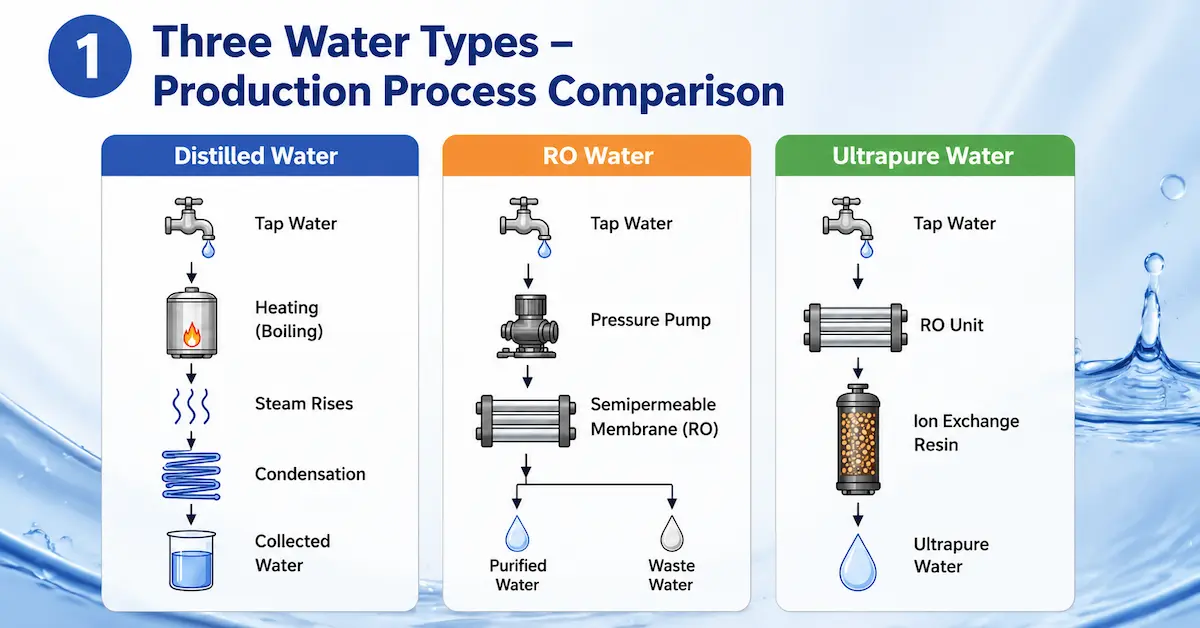


Wastewater Ratio: Is 2:1 Better Than 3:1?
When comparing reverse osmosis (RO) water purifiers, one specification often catches the attention of buyers: the wastewater ratio. Product brochures frequently highlight figures such as 2:1, 3:1, or even higher recovery ratios, leading many consumers to believe that a larger number automatically represents a better water purifier.
At first glance, this assumption seems reasonable. A higher recovery ratio means that more purified water is produced while less water is discharged as concentrate, suggesting improved water efficiency. However, wastewater ratio is only one aspect of an RO system's overall design. Evaluating a purifier solely on this specification can overlook more important factors, including membrane protection, operating stability, maintenance costs, and long-term reliability.
In reality, achieving a high recovery ratio involves engineering trade-offs. Reducing the amount of reject water means the membrane operates under higher concentrations of dissolved minerals, which may increase the risk of scaling and membrane fouling if the system is not carefully designed. For manufacturers, finding the right balance between water efficiency and membrane longevity is often more important than simply maximizing recovery.
For distributors, wholesalers, OEM buyers, and engineers, understanding how wastewater ratio affects overall system performance is essential when evaluating different RO water purifier designs.
This article explains the technical principles behind wastewater ratio, compares 2:1 and 3:1 recovery ratios, and discusses why the highest recovery rate is not always the most practical choice.
What Is Wastewater Ratio in an RO Water Purifier?
Before comparing different recovery ratios, it is important to understand what wastewater ratio actually means.
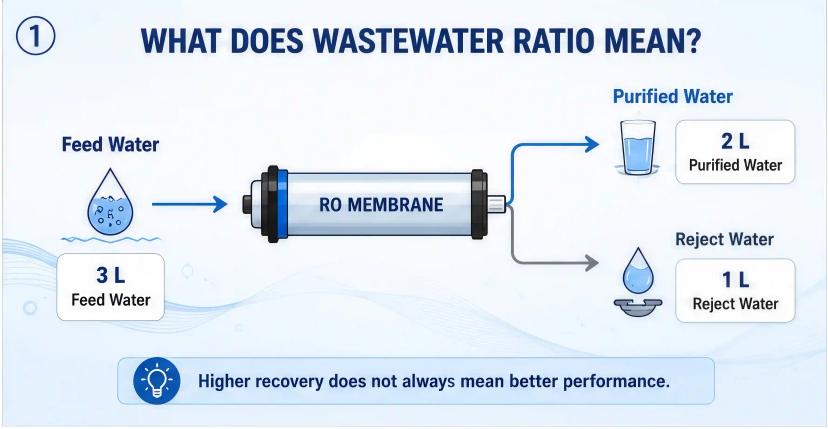
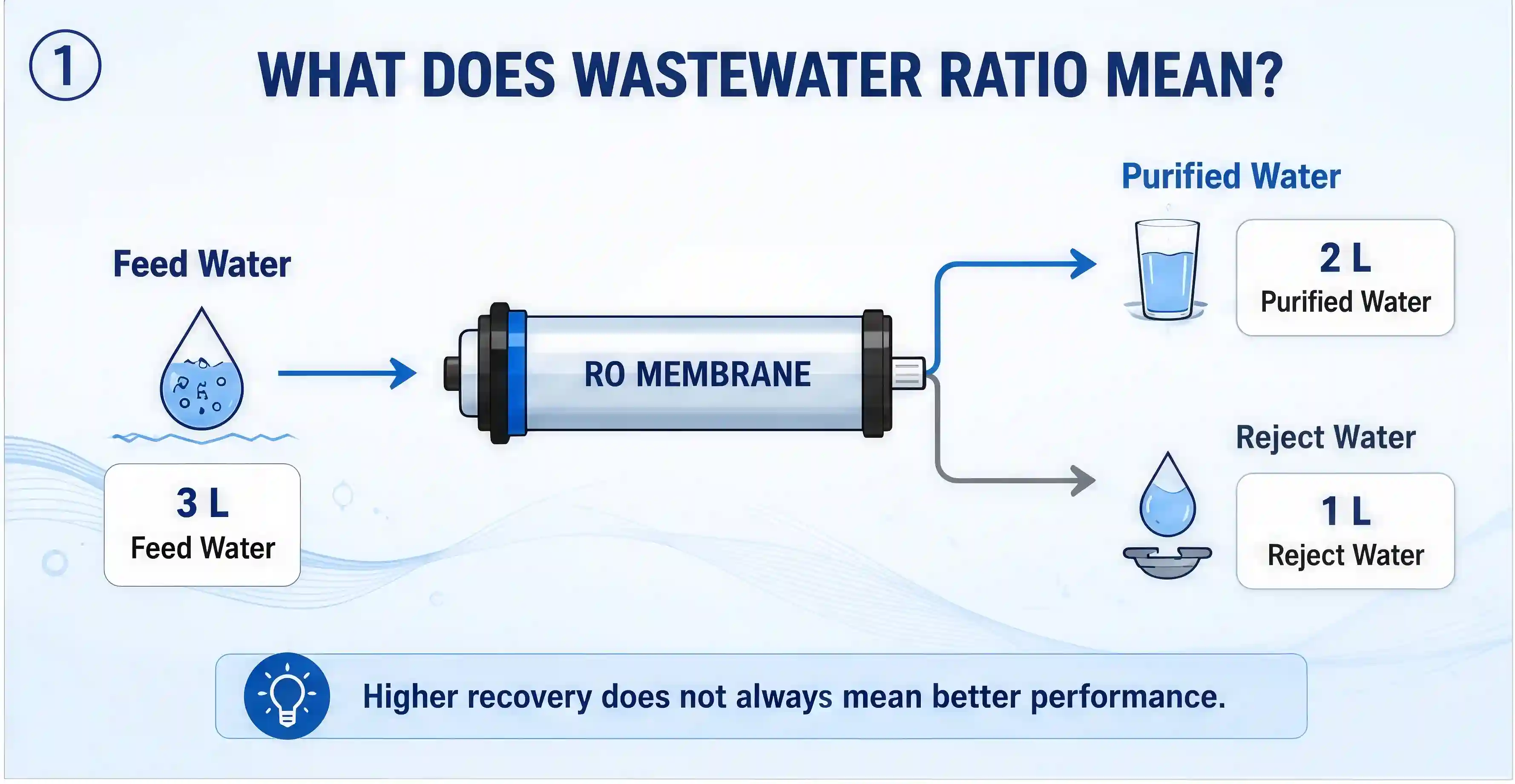
Unlike conventional filtration technologies, reverse osmosis separates incoming feed water into two different streams.
The first stream is purified water, also known as permeate. This is the treated water that passes through the semi-permeable RO membrane and is suitable for drinking or other applications.
The second stream is reject water, sometimes referred to as concentrate or brine. This stream carries away dissolved minerals, salts, heavy metals, and other contaminants that cannot pass through the membrane.
Many people mistakenly view reject water as wasted water. From an engineering perspective, however, reject water performs an essential function.
As contaminants accumulate on the membrane surface during filtration, the reject water continuously flushes them away. This flushing action helps prevent mineral deposits from building up on the membrane, reducing fouling and extending membrane service life.
Without sufficient concentrate flow, contaminants remain on the membrane surface for longer periods, increasing the likelihood of scaling, clogging, and declining filtration performance.
Therefore, reject water should not simply be regarded as a loss of water. Instead, it is an integral part of the RO purification process that helps maintain stable system performance.
Another important concept closely related to wastewater ratio is the recovery rate.
Recovery rate refers to the percentage of feed water converted into purified water.
For example:
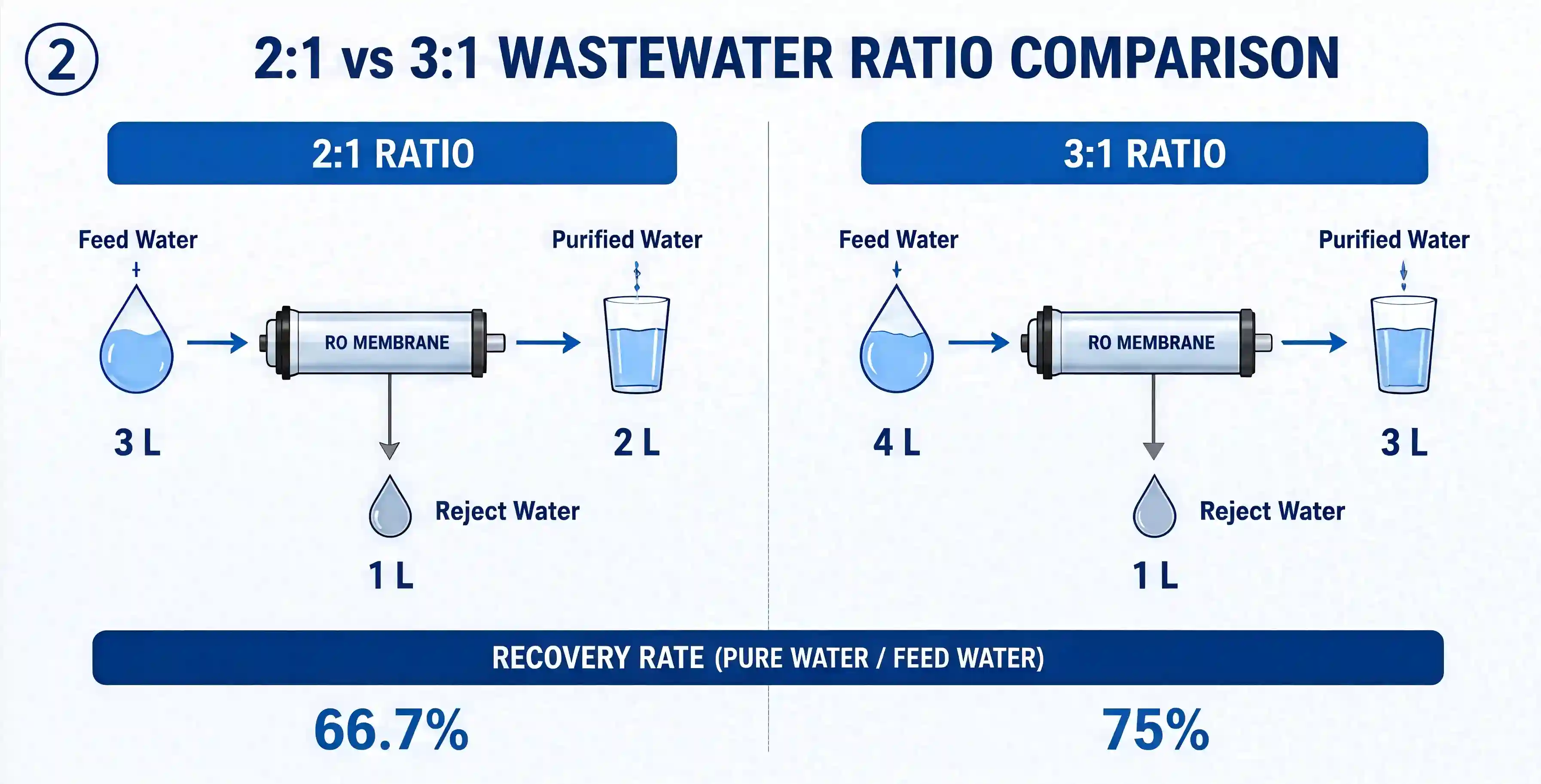
- A 2:1 wastewater ratio means two parts purified water and one part reject water. The corresponding recovery rate is approximately 66.7%.
- A 3:1 wastewater ratio means three parts purified water and one part reject water, resulting in a recovery rate of approximately 75%.
Although a higher recovery rate appears more water-efficient, increasing recovery also reduces the volume of flushing water available to protect the membrane.
This is why engineers rarely evaluate wastewater ratio in isolation. Instead, they consider the relationship between water recovery, membrane protection, operating pressure, feed water quality, and expected service life.
How Are 2:1 and 3:1 Wastewater Ratios Calculated?
Understanding the mathematics behind wastewater ratio makes it easier to compare different RO systems.
A wastewater ratio describes the relationship between purified water and reject water produced during filtration.
For a 2:1 system, the process is relatively straightforward.
Suppose an RO purifier receives 3 liters of feed water.
During filtration:
- Approximately 2 liters become purified drinking water.
- Approximately 1 liter is discharged as reject water.
This produces a purified-to-reject ratio of 2:1, with a recovery rate close to 66.7%.
A 3:1 system operates differently.
If 4 liters of feed water enter the membrane:
- Approximately 3 liters become purified water.
- Approximately 1 liter becomes reject water.
This increases the recovery rate to approximately 75%.
At first glance, the difference seems significant. Producing more purified water from the same amount of feed water appears to represent a technological improvement.
However, the engineering reality is more complex.
As recovery increases, the concentration of dissolved minerals remaining inside the membrane also increases. Calcium, magnesium, silica, and other scaling compounds become progressively more concentrated during filtration.
This means the membrane must operate under more challenging conditions.
To maintain stable operation at higher recovery rates, manufacturers often need to optimize several components simultaneously, including:
- RO membrane selection
- Flow restrictor sizing
- Booster pump pressure
- Automatic flushing algorithms
- Control software
- Feed water quality management
Without careful optimization, simply increasing the recovery rate may reduce membrane lifespan instead of improving overall system efficiency.
For this reason, wastewater ratio should be viewed as the result of an integrated system design rather than an isolated product specification.
Why Do Manufacturers Use Different Wastewater Ratios?
One question frequently raised by buyers is why different manufacturers promote different wastewater ratios if one ratio is supposedly better than another.
The answer lies in engineering priorities rather than marketing alone.
Every RO water purifier is designed with a specific balance between water efficiency, membrane protection, manufacturing cost, maintenance requirements, and expected operating conditions.
For example, an RO system intended for regions with relatively soft municipal water may safely operate at a higher recovery rate because the risk of mineral scaling is relatively low. In these applications, manufacturers may optimize the system to achieve a 3:1 wastewater ratio without significantly affecting membrane life.
In contrast, systems designed for areas with hard water or higher total dissolved solids (TDS) often require more frequent membrane flushing. These products may intentionally use a 2:1 or even lower recovery ratio to reduce scaling and improve long-term reliability.
Commercial and industrial RO systems demonstrate this principle even more clearly. Rather than targeting a single wastewater ratio, engineers calculate recovery based on feed water chemistry, operating pressure, pretreatment efficiency, membrane configuration, and cleaning intervals. The goal is to maximize overall system performance instead of achieving the highest possible recovery number.
As a result, wastewater ratio should always be interpreted within the context of the complete RO system design.
A well-engineered 2:1 system may deliver better long-term performance than a poorly optimized 3:1 system, particularly in challenging water conditions.
Why a Higher Recovery Ratio Is Not Always Better
At first glance, a higher wastewater ratio appears to be a clear advantage. Producing more purified water while discharging less concentrate sounds like the ideal solution for both water conservation and operating efficiency.
However, experienced engineers rarely judge an RO system based solely on its recovery rate.
In membrane filtration, every design decision involves balancing multiple performance factors. Increasing water recovery may reduce water consumption, but it also changes the operating environment inside the membrane. As recovery increases, the concentration of dissolved minerals rises, placing greater stress on the filtration system.
For this reason, wastewater ratio should be evaluated alongside membrane protection, feed water quality, maintenance frequency, and long-term operating costs rather than as an independent performance indicator.
The following sections explain why maximizing recovery is not always the most practical engineering approach.
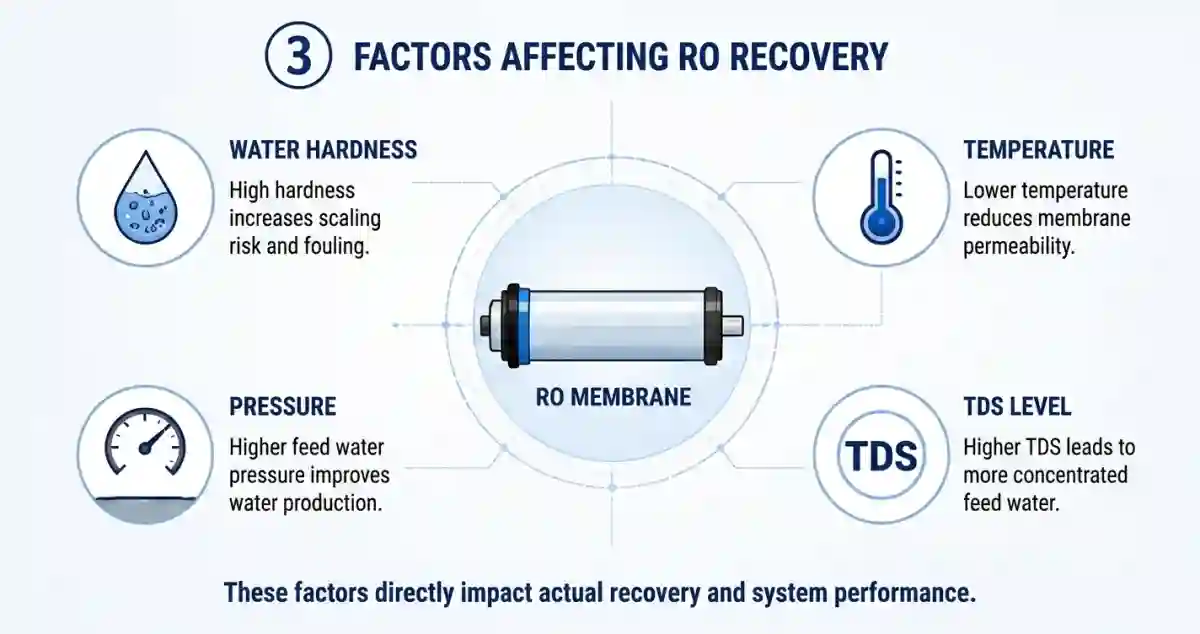
Higher Recovery Increases Scaling Risk
Reverse osmosis membranes remove a wide range of dissolved substances from water, including calcium, magnesium, silica, sodium salts, and many other minerals.
These contaminants do not disappear during filtration. Instead, they remain in the concentrate stream.
When an RO system operates at a higher recovery rate, less water is discharged as reject water. As a result, dissolved minerals become increasingly concentrated around the membrane surface.
Over time, this concentrated solution can exceed the solubility limits of certain minerals, causing them to precipitate and form scale deposits on the membrane.
Common types of membrane scaling include:
- Calcium carbonate
- Calcium sulfate
- Magnesium hydroxide
- Silica deposits
- Iron fouling (in certain water sources)
Scaling reduces membrane permeability, decreases permeate flow, increases operating pressure, and ultimately shortens membrane service life.
Removing heavy scale often requires chemical cleaning or membrane replacement, both of which increase maintenance costs and system downtime.
For residential RO systems, these problems may appear gradually over months or years. In commercial installations, however, membrane fouling can significantly affect production efficiency and operating expenses if recovery is pushed beyond appropriate design limits.
Reject Water Plays an Essential Role
One of the biggest misconceptions surrounding RO systems is the idea that reject water is simply wasted water.
From a technical perspective, reject water performs a critical maintenance function.
As feed water flows across the membrane surface, contaminants accumulate continuously. The reject stream carries these concentrated impurities away before they can permanently adhere to the membrane.
This process is known as crossflow flushing.
Without adequate flushing, contaminants remain on the membrane for longer periods, increasing the likelihood of:
- Scale formation
- Organic fouling
- Biofilm growth
- Reduced membrane permeability
In other words, reject water acts as the membrane's self-cleaning mechanism during normal operation.
Reducing reject water too aggressively may improve recovery in the short term, but it can also reduce the membrane's ability to remove accumulated contaminants effectively.
Modern RO system design therefore focuses on finding an appropriate balance between water conservation and membrane protection rather than eliminating reject water altogether.
Higher Recovery May Increase Long-Term Operating Costs
Many purchasing decisions focus primarily on water savings.
While reducing wastewater is certainly beneficial, the financial picture is more complex when evaluated over the entire service life of an RO system.
Consider two systems with similar filtration performance:
- System A operates at a 2:1 wastewater ratio.
- System B operates at a 3:1 wastewater ratio.
Under ideal conditions, System B consumes less feed water to produce the same amount of purified water.
However, if the higher recovery rate causes the membrane to foul more quickly, maintenance costs may increase over time.
Potential long-term expenses include:
- More frequent membrane replacement
- Increased filter maintenance
- Higher service labor costs
- Additional system downtime
- Greater energy consumption due to increased operating pressure
For commercial users operating hundreds or thousands of liters per day, these maintenance costs often have a much greater financial impact than relatively small reductions in water consumption.
Consequently, many engineers evaluate total cost of ownership (TCO) rather than water recovery alone when selecting an RO system.
Feed Water Quality Has a Major Influence
No wastewater ratio can be evaluated without considering feed water quality.
The same RO purifier may perform very differently when installed in different regions.
Several water quality parameters influence achievable recovery rates:
Total Dissolved Solids (TDS)
Higher TDS increases osmotic pressure and leaves more dissolved minerals in the concentrate stream, making membrane scaling more likely.
Water Hardness
High concentrations of calcium and magnesium significantly increase scaling potential, especially at higher recovery rates.
Silica Content
Silica is particularly difficult to remove once deposited on the membrane surface and often limits maximum recovery in many RO applications.
Iron and Manganese
Without proper pretreatment, these contaminants can rapidly foul membranes and reduce filtration performance.
Because municipal water quality varies widely between cities and countries, manufacturers cannot guarantee that a laboratory recovery ratio will always be achieved in real-world installations.
Instead, wastewater ratio should always be considered together with local water conditions and pretreatment requirements.
Does a 3:1 Wastewater Ratio Really Save More Water?
The short answer is yes—but the overall benefit depends on the application.
A 3:1 recovery ratio does produce more purified water from the same volume of feed water than a 2:1 system. From a purely mathematical perspective, this represents improved water efficiency.
However, understanding the practical significance requires looking beyond percentages.
Imagine a household producing approximately 6 liters of drinking water per day.
Over an entire year, the difference in water consumption between a 2:1 and a 3:1 recovery ratio is relatively modest compared with total household water use.
For most families, this reduction represents only a small fraction of annual water consumption.
At the same time, membrane replacement, filter maintenance, and service costs may vary considerably depending on operating conditions and membrane health.
Therefore, the economic advantage of a higher recovery ratio should be evaluated over the complete lifecycle of the system rather than by water consumption alone.
Comparison of Typical Recovery Ratios
| Wastewater Ratio | Approximate Recovery Rate | Water Efficiency | Membrane Protection | Scaling Risk | Typical Application |
|---|---|---|---|---|---|
| 1:1 | 50% | Moderate | Excellent | Very Low | Hard water areas |
| 2:1 | 66.7% | High | Very Good | Low | Most residential RO systems |
| 3:1 | 75% | Very High | Moderate | Medium | Optimized systems with suitable feed water |
The table illustrates an important engineering principle:
Higher recovery improves water efficiency, but it also reduces the safety margin available for membrane protection.
This is why reputable manufacturers design recovery ratios according to expected operating conditions rather than selecting the highest possible value for marketing purposes.
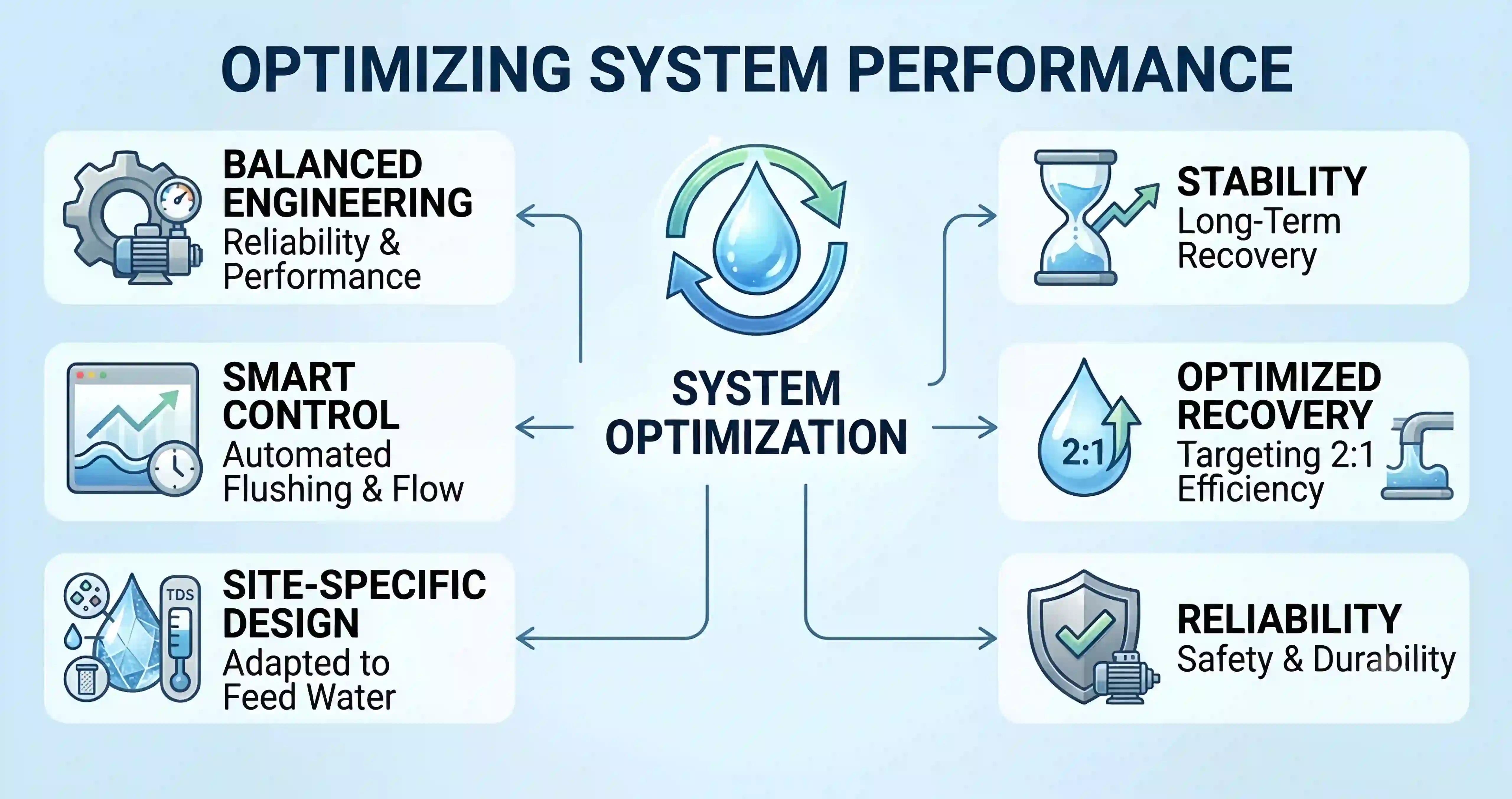
In professional RO system design, success is not defined by achieving the highest recovery ratio. Instead, it is measured by delivering stable water quality, reliable operation, reasonable maintenance costs, and long membrane service life under real operating conditions.
A wastewater ratio should therefore be viewed as one element of a comprehensive engineering solution—not as a standalone indicator of product quality.
National Water Efficiency Standards: Understanding Recovery Beyond Marketing Numbers
Water conservation has become an increasingly important consideration for both manufacturers and consumers. As governments introduce stricter environmental regulations, many countries have established standards to encourage the development of more water-efficient purification systems.
However, it is important to understand that water efficiency standards are not designed to reward the highest possible recovery ratio at any cost.
Instead, these standards aim to balance several critical performance indicators, including:
- Water recovery
- Drinking water quality
- System safety
- Long-term operating stability
- Energy consumption
- Product reliability
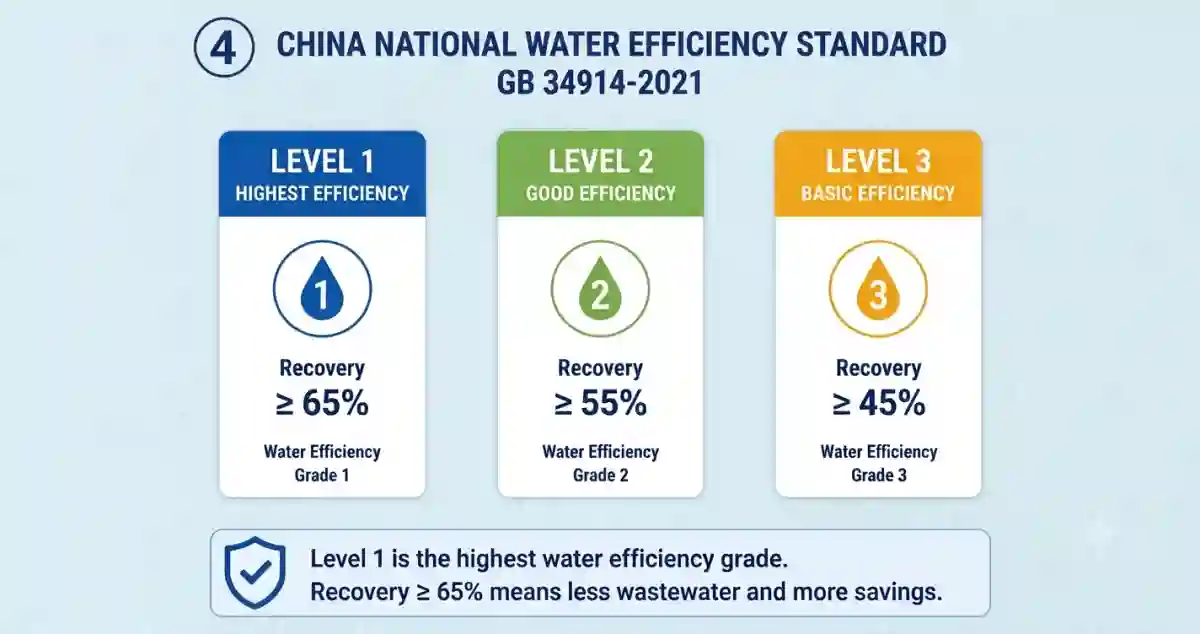
For example, China's GB 34914-2021 Water Efficiency Standard classifies residential reverse osmosis water purifiers according to their recovery performance. Products that achieve a recovery rate of 65% or higher qualify for the highest water-efficiency level.
A recovery rate of approximately 66.7%, which corresponds to a 2:1 purified-to-reject water ratio, already satisfies this requirement.
This is an important point because it demonstrates that a well-designed 2:1 RO system can already achieve high water efficiency while maintaining an appropriate level of membrane flushing.
Similar engineering principles can also be found in commercial RO systems worldwide. Although specific regulatory requirements differ between countries, system designers generally avoid maximizing recovery beyond what the feed water conditions can safely support.
Instead, recovery is optimized based on factors such as:
- Feed water chemistry
- Scaling potential
- Pretreatment quality
- Membrane characteristics
- Operating pressure
- Maintenance strategy
This approach improves the overall reliability of the system rather than focusing solely on a single performance number.
Why Water Efficiency Is More Than a Single Number
A common misunderstanding among first-time buyers is that wastewater ratio alone determines whether one RO system is superior to another.
In reality, engineers evaluate water efficiency using multiple performance indicators simultaneously.
For example, two water purifiers may both advertise a 3:1 recovery ratio, yet perform very differently over several years of operation.
The difference often comes from factors such as:
- Membrane quality
- Pump stability
- Automatic flushing strategy
- Pressure regulation
- Flow restrictor accuracy
- Control algorithm optimization
A system with excellent component integration may maintain stable performance for years, while another system with similar published specifications may experience premature membrane fouling or inconsistent recovery.
This is why experienced buyers often request complete technical documentation rather than comparing product brochures alone.
Why Marketing Claims Can Be Misleading
As consumer interest in water-saving appliances has increased, wastewater ratio has become a common marketing highlight.
Many advertisements emphasize statements such as:
- "3:1 Water Saving"
- "Ultra-Low Wastewater"
- "High Recovery Technology"
- "Zero Wastewater"
Although these claims may sound impressive, they often require additional explanation.
Understanding the conditions behind these numbers helps buyers evaluate products more objectively.
Laboratory Performance Is Different from Real-World Operation
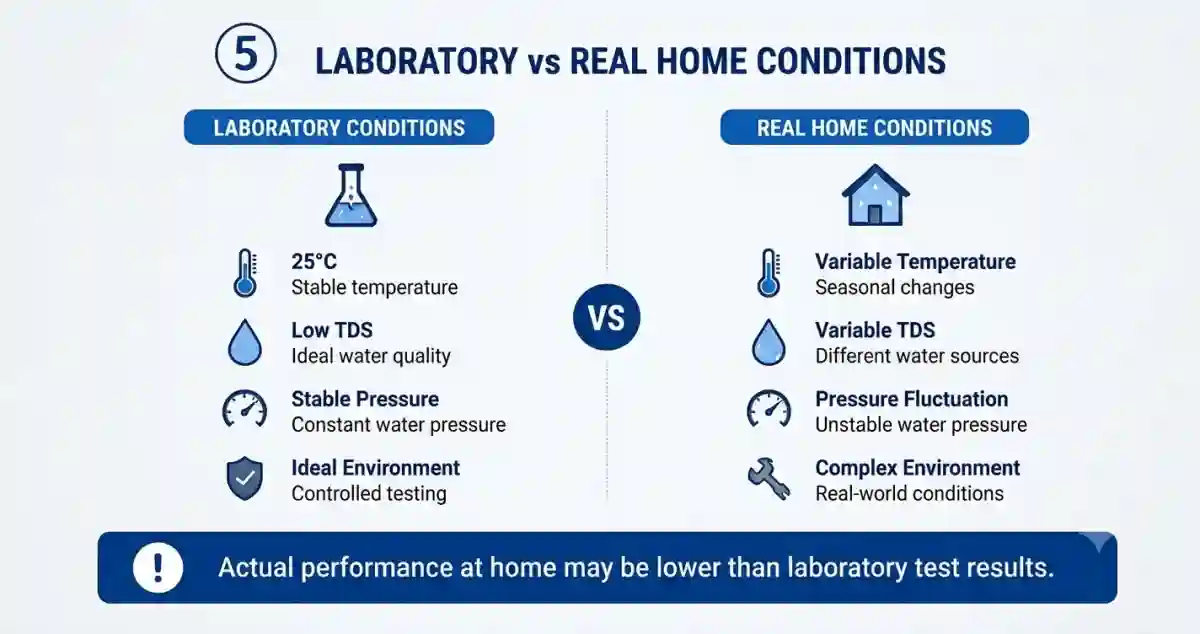
Most published recovery ratios are measured under standardized laboratory conditions.
Typical testing environments include:
- Stable feed water pressure
- Controlled water temperature
- Low mineral concentration
- New membrane
- Clean filters
- Consistent electrical supply
These controlled conditions provide useful reference data because every product is tested using the same methodology.
However, actual household environments rarely remain this stable.
Real-world performance varies continuously due to changing operating conditions.
For example:
Seasonal Temperature Changes
Cold water passes through RO membranes more slowly than warm water.
During winter, membrane permeability naturally decreases, reducing purified water production while increasing the amount of concentrate required to maintain proper flushing.
As a result, wastewater ratio may temporarily decrease even though the purifier is operating normally.
Regional Water Quality Differences
Feed water quality varies considerably around the world.
Some regions receive relatively soft municipal water with low dissolved mineral content.
Others have naturally hard groundwater containing high concentrations of calcium, magnesium, silica, or iron.
Higher mineral concentrations increase scaling potential, making lower recovery ratios more appropriate for long-term membrane protection.
This explains why the same purifier may achieve different recovery ratios in different cities.
Water Pressure Fluctuations
Reverse osmosis relies on pressure to overcome natural osmotic pressure across the membrane.
If incoming water pressure changes throughout the day, purified water production may also fluctuate.
Low pressure often reduces recovery because additional flushing is required to maintain stable filtration.
Conversely, excessive pressure may increase membrane stress if not properly regulated.
Modern RO systems therefore incorporate pressure management into their overall design.
Filter Age and Membrane Condition
Another important factor is system age.
As pre-filters gradually become clogged with sediment and contaminants, flow resistance increases.
Similarly, membrane fouling develops naturally over time, even under normal operating conditions.
To compensate, many intelligent RO systems automatically adjust flushing frequency or recovery settings to protect the membrane.
This means wastewater ratio naturally changes throughout the product's service life.
Rather than indicating poor performance, these adjustments often represent intelligent system protection.
Is "Zero Wastewater" Really Possible?
Another claim occasionally seen in the market is the concept of a "zero wastewater" water purifier.
From a technical perspective, this statement requires careful interpretation.
A true reverse osmosis membrane always generates a concentrate stream.
Without reject water, dissolved contaminants cannot be continuously removed from the membrane surface.
Some products marketed as "zero wastewater" may temporarily recycle concentrate water back into the feed tank or storage system.
Others may actually use ultrafiltration (UF) instead of reverse osmosis.
Although ultrafiltration effectively removes suspended particles and certain microorganisms, it cannot remove dissolved salts, heavy metals, or many other contaminants to the same extent as RO membranes.
Therefore, buyers should always verify the filtration technology behind marketing claims instead of relying on advertising terminology alone.
Understanding the difference between RO and UF technology helps prevent unrealistic expectations regarding wastewater generation and drinking water quality.
Which Wastewater Ratio Should You Choose?
After understanding how wastewater ratio works, a practical question naturally follows:
Which recovery ratio is the right choice?
There is no universal answer because the ideal wastewater ratio depends on the intended application, feed water quality, operating environment, and maintenance strategy.
Rather than asking whether 2:1 is better than 3:1, a more useful question is:
Which recovery ratio provides the best balance for the specific application?
Professional RO system designers rarely begin with a target wastewater ratio. Instead, they first evaluate the water source, system capacity, expected operating hours, maintenance schedule, and customer priorities. Only after considering these factors do they determine an appropriate recovery rate.
The following recommendations provide a general reference for common applications.
Recommended Wastewater Ratios by Application
| Application | Recommended Ratio | Reason |
|---|---|---|
| Municipal water with low TDS | Up to 3:1 | Lower scaling risk allows higher recovery. |
| Typical residential drinking water | Around 2:1 | Provides an excellent balance between water efficiency and membrane protection. |
| Hard water or high-TDS regions | 1:1–2:1 | Increased flushing helps reduce scaling and extend membrane life. |
| Commercial RO systems | Determined by engineering design | Recovery should be optimized according to feed water analysis and operating requirements. |
| Industrial RO systems | Project-specific | Pretreatment, membrane configuration, and cleaning strategy are more important than a fixed ratio. |
These recommendations should be viewed as engineering guidelines rather than strict rules. A well-designed system operating at a 2:1 ratio may outperform a poorly designed 3:1 system in terms of reliability, maintenance cost, and overall lifecycle value.
What Should Professional Buyers Focus On?
For OEM buyers, distributors, importers, and project engineers, wastewater ratio should be considered as one parameter within the overall system design rather than the primary purchasing criterion.
When evaluating an RO water purifier, consider the following questions:
Is the Recovery Ratio Stable?
A recovery ratio measured under laboratory conditions may differ from actual field performance. Ask whether the published specification reflects realistic operating conditions and whether the system can maintain stable recovery over time.
Does the System Protect the RO Membrane?
Membrane replacement is one of the most significant long-term maintenance costs in any RO system.
Evaluate whether the purifier includes features such as:
- Automatic flushing
- Optimized flow restrictor design
- Stable operating pressure
- Appropriate concentrate flow
- Intelligent control algorithms
These design elements often have a greater impact on system reliability than achieving the highest recovery ratio.
Can the System Adapt to Different Water Conditions?
Water quality varies significantly between countries and even between neighboring cities.
Modern RO systems increasingly incorporate intelligent controls that adjust flushing frequency or operating parameters according to changing feed water conditions.
Adaptive control strategies help maintain consistent performance while reducing unnecessary membrane stress.
What Is the Total Cost of Ownership?
The purchase price represents only one portion of the overall investment.
Professional buyers should also evaluate:
- Membrane replacement frequency
- Filter replacement intervals
- Energy consumption
- Service requirements
- Spare part availability
- Expected operating life
A system with slightly lower recovery but significantly lower maintenance costs may provide greater long-term value.
Frequently Asked Questions
Is a 3:1 wastewater ratio always better than 2:1?
No. A higher recovery ratio improves water efficiency but also reduces the amount of concentrate available to flush the membrane. The optimal ratio depends on feed water quality, system design, and long-term maintenance considerations.
Why does an RO purifier produce reject water?
Reject water carries away dissolved minerals and contaminants that accumulate on the membrane surface. Without this flushing process, the membrane would foul much more quickly, reducing filtration performance and service life.
Can an RO water purifier operate without wastewater?
No. All reverse osmosis systems generate a concentrate stream during normal operation. Claims of "zero wastewater" should be evaluated carefully to determine whether they refer to recycled concentrate or a different filtration technology, such as ultrafiltration.
Does higher recovery reduce operating costs?
Not necessarily.
Higher recovery lowers water consumption but may increase membrane fouling if the system is not properly designed. Long-term operating costs depend on water quality, maintenance requirements, and membrane lifespan.
Why does wastewater ratio change throughout the year?
Seasonal temperature changes, water pressure fluctuations, feed water quality, and filter condition all affect RO system performance. As a result, the actual recovery ratio may vary while the purifier continues to operate normally.
Should distributors compare wastewater ratio when selecting OEM suppliers?
Wastewater ratio is an important specification, but it should be evaluated alongside membrane quality, intelligent control, component reliability, certification, after-sales support, and overall engineering design.
Conclusion
The wastewater ratio of an RO water purifier is far more than a simple marketing specification. It reflects the balance between water efficiency, membrane protection, operating stability, and long-term maintenance.
Although higher recovery ratios such as 3:1 may appear more attractive at first glance, they do not automatically indicate a superior product. Achieving high recovery requires careful engineering, including optimized membrane selection, pressure management, concentrate flow control, and intelligent flushing strategies. Without these supporting elements, excessive recovery may increase scaling potential and reduce membrane lifespan.
By comparison, a 2:1 wastewater ratio often represents a well-balanced design for many residential applications. It provides high water efficiency while maintaining sufficient concentrate flow to protect the membrane and support stable long-term performance. This balance explains why many modern residential RO systems are engineered around recovery rates in this range.
Ultimately, the most appropriate wastewater ratio depends on the application rather than a single published specification. Water quality, operating environment, maintenance strategy, and overall system design all play critical roles in determining real-world performance.
For professional buyers, the most effective approach is to evaluate an RO system as a complete engineering solution. Instead of focusing solely on wastewater ratio, consider how all system components work together to deliver consistent water quality, reliable operation, efficient maintenance, and long service life.
As water treatment technologies continue to evolve, future innovations are likely to focus not only on improving recovery rates but also on integrating intelligent control systems, adaptive flushing algorithms, advanced membrane materials, and data-driven performance optimization. These developments will enable manufacturers to achieve greater water efficiency while preserving the reliability and durability that end users expect.