

1. Introduction: The Real Pain Point of Water Purifiers Is Not Filtration – It’s Leakage
For household RO water purifiers, consumers are often less concerned about filtration accuracy – because RO membrane technology is already mature enough. The real issue that makes users hesitate, installers worry, and after-sales teams work overtime is water leakage.
A loose connection, an aged seal ring, or improper installation can lead to soaked cabinets, damaged floors, or even disputes with neighbors. Leakage not only affects user experience but also directly impacts brand reputation and after-sales costs.
As a manufacturing factory specializing in compact, tankless RO systems, INTOPAQUA understands how leakage hinders industry growth. That’s why, from the very beginning of product design, we have treated “leak prevention” as equally important as “filtration performance,” building a complete four-level leak protection system.
2. Level One Leak Protection: Integrated Waterway Board – 70% Fewer Connectors
2.1 Structural Flaws of Traditional RO Systems
Traditional RO systems use a multi-point waterway design: pre-filters, RO membrane, booster pump, solenoid valve, faucet, and other components are connected through many PE tubes and quick-connect fittings. A typical traditional RO unit often has 15–20 or more internal connectors.
Each connector is a potential leak point. Over time, O-rings age, tubes creep, and vibrations loosen connections. Small leaks often go unnoticed until significant damage occurs.
2.2 INTOPAQUA’s Innovative Integrated Waterway Board
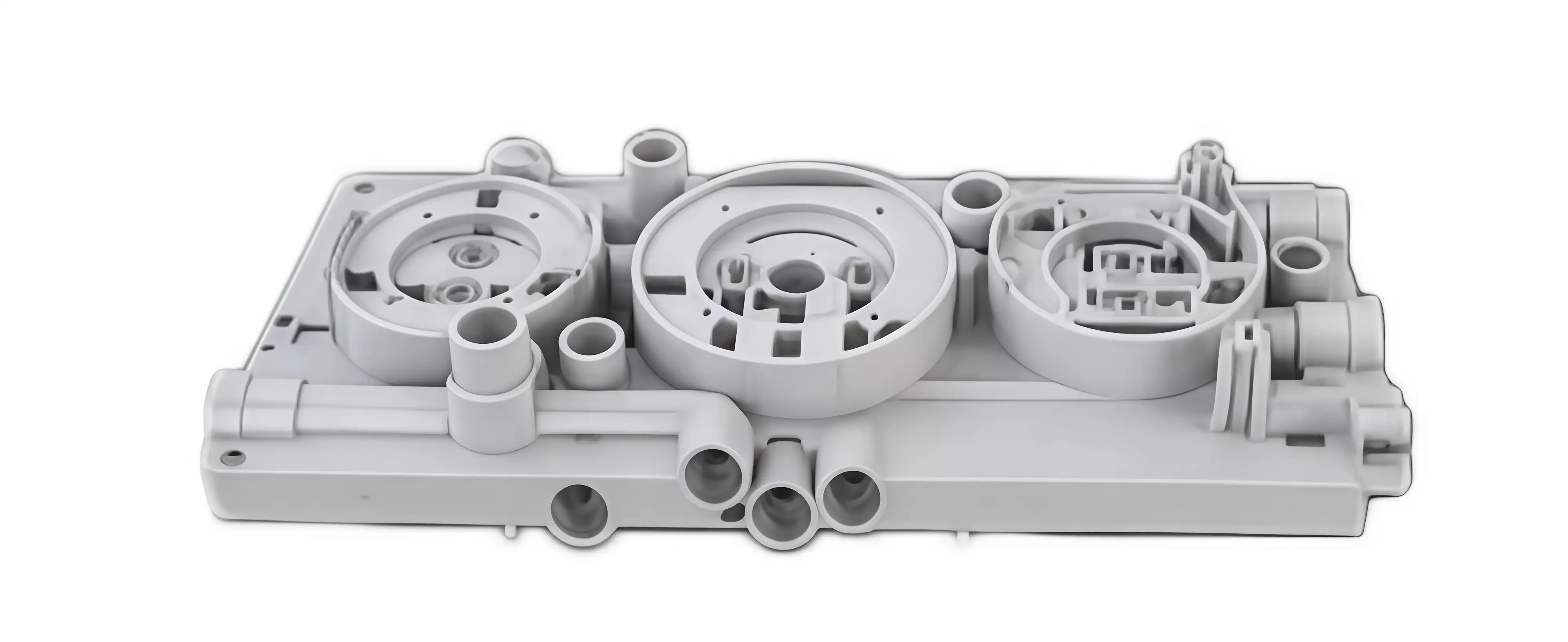
INTOPAQUA’s compact RO systems use an injection-molded integrated waterway board that consolidates multiple flow channels inside a single, high-strength plastic base. Water flows through internal channels rather than separate tubes.
The result: a 70% reduction in the number of connection ports.
Take a typical INTOPAQUA tankless RO model:
-
Traditional design: approximately 18 connectors
-
With integrated waterway board: only 5–6 external connectors remain
2.3 Why Fewer Connectors Means Lower Leak Risk
Every eliminated connector means:
-
One less O-ring that can age
-
One less assembly error possibility
-
One less point that can be pulled or stressed
Real-world production and after-sales data show that INTOPAQUA products with the integrated waterway board reduce leakage-related failures by an order of magnitude compared to traditional designs.
2.4 Additional Benefits of the Integrated Waterway Board
Beyond leak prevention, the integrated waterway board brings:
-
Smaller overall size – ideal for tight under-sink spaces
-
Higher assembly efficiency and better consistency
-
More uniform internal flow resistance – stable operation
-
Fewer parts – lower procurement and inventory complexity
3. Level Two Leak Protection: Leak Protection Board – Active Detection and Automatic Shutoff
While the integrated waterway board focuses on prevention, the leak protection board takes active action.
3.1 What Is a Leak Protection Board?
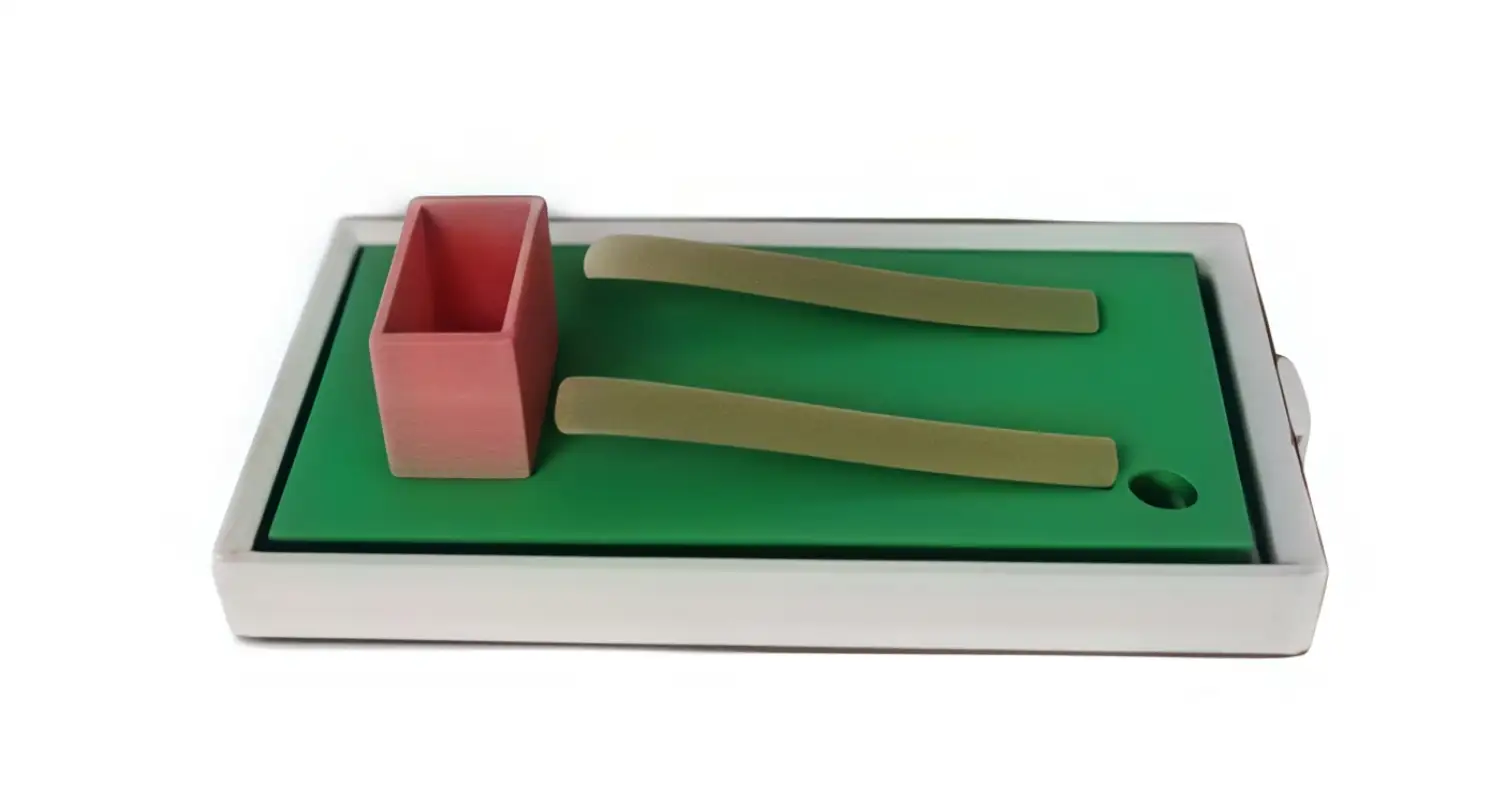
INTOPAQUA’s compact RO systems integrate a leak protection board at the bottom of the unit. This thin component contains leak detection sensors and is installed at the lowest point of the system – making it the most important active protection device.
Detection principle: using water’s conductivity or a physical contact mechanism, when water accumulates on the board’s surface, the sensor circuit is triggered, immediately activating alarm and shutoff logic.
3.2 Automatic Response When a Leak Is Detected
Once the leak protection board is triggered, INTOPAQUA’s control system performs two actions within seconds:
-
Audible/visual alarm – alerts the user of an abnormal condition
-
Automatic inlet water shutoff – cuts off the water supply to prevent further leakage
Even when no one is home, this prevents catastrophic “leaking overnight” scenarios.
3.3 What Scenarios Does the Leak Protection Board Address?
In real-world use, leaks can come from many causes:
-
Accidental rupture of internal tubing
-
Improper filter installation causing seepage
-
Unit being knocked over or vibrated
-
User error spilling water into the unit
-
Condensation in high-humidity environments
Regardless of the cause, the leak protection board acts as the last physical line of defense, minimizing damage. This is especially important for under-sink installations where leaks may not be noticed immediately.
3.4 Leak Protection Is Becoming Industry Standard
In the past, leak protection was reserved for high-end models. But in INTOPAQUA’s philosophy, safety should not be a premium add-on – it should be a basic feature of every unit. Today, in the US and Chinese markets, leak protection boards are rapidly becoming standard on compact RO systems, driven by consumer and market demand.
4. Level Three Leak Protection: High-Pressure and Air Tightness Testing – Dual Verification Before Shipment
Great design requires reliable manufacturing. No matter how good the waterway board or leak protection board is, lax production control will still lead to problems.
4.1 High-Pressure Testing: Simulating the Harshest Conditions
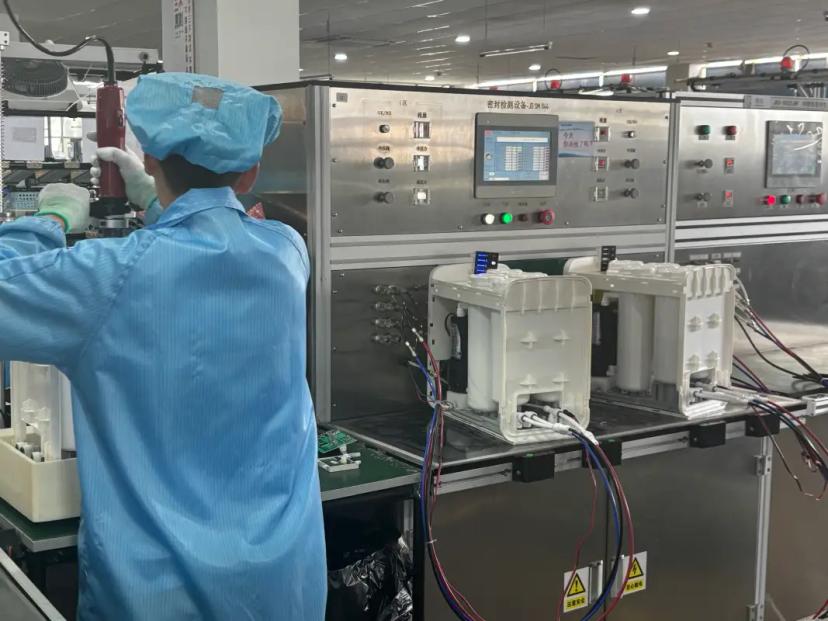
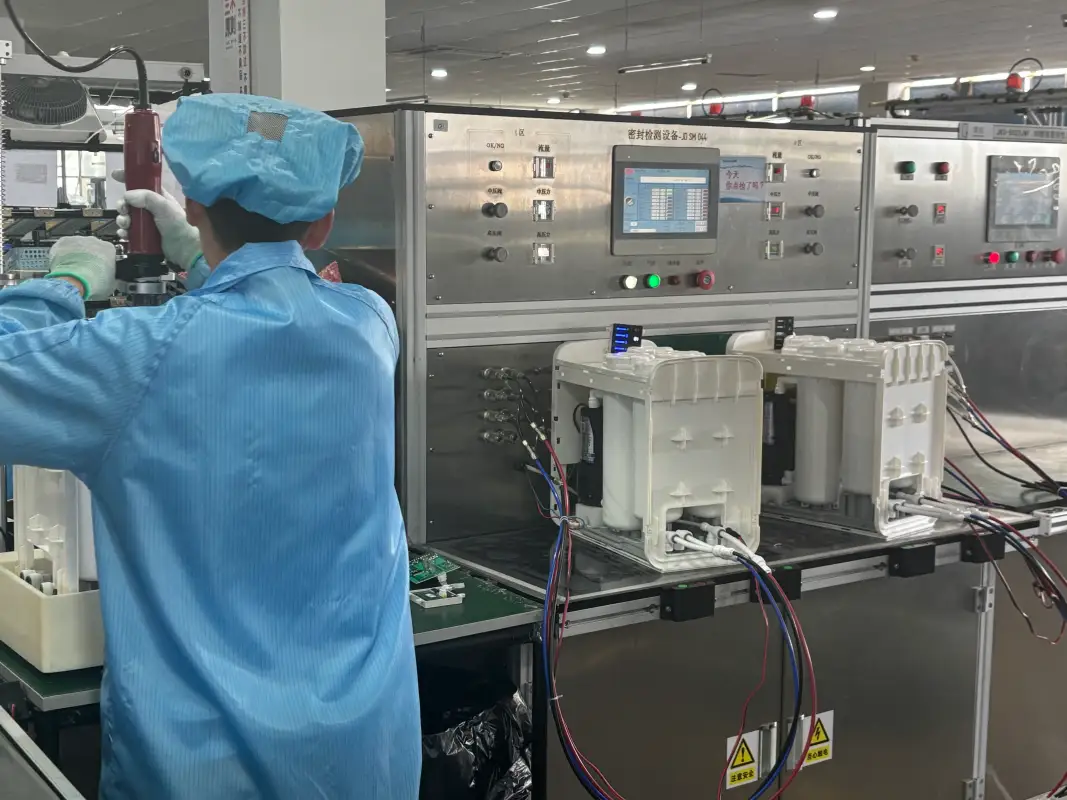
In INTOPAQUA’s production process, every assembled waterway board and complete unit undergoes high-pressure testing. The method: apply water pressure higher than normal operating pressure (typically 1.5× operating pressure or higher) for a set duration, checking for leaks, deformation, or rupture.
High-pressure testing simulates harsh real-world conditions including:
-
Municipal water pressure fluctuations
-
Water hammer effects (sudden pressure spikes from fast faucet closure)
-
Thermal expansion and contraction under extreme temperatures
Only units that pass high-pressure testing move to the next stage.
4.2 Air Tightness Testing: More Sensitive Than Water Testing
Air tightness testing is another critical quality checkpoint in INTOPAQUA’s process. Instead of water, compressed air is introduced into the waterway system, and high-precision sensors detect any pressure drop.
Why air tightness testing?
-
Air can pass through microscopic gaps more easily than water
-
It can detect tiny leaks invisible to the naked eye or even water testing
-
Fast testing speed – suitable for mass production
In INTOPAQUA’s factory, air tightness testing is integrated with automated equipment. Every unit has its own test data and records, achieving 100% inspection and full traceability.
4.3 What Dual Testing Achieves
High-pressure + air tightness testing covers reliability verification across multiple dimensions:
-
The inherent sealing quality of the waterway board itself
-
Assembly quality of all components (solenoid valves, fittings, filter housings, etc.)
-
Incoming quality of sourced parts
For users and distributors, this means every INTOPAQUA unit has been thoroughly screened for leaks before leaving the factory – not just “batch sampling” statistical comfort.
5. Level Four Leak Protection: 30-Minute Automatic Shutdown – Guarding Against Human Error
This is a highly practical but often underestimated protection mechanism.
5.1 How It Works
INTOPAQUA’s compact RO systems include intelligent control logic: when the unit runs continuously for 30 minutes, regardless of whether it is still producing water, the control system automatically cuts power and stops operation. The user must manually restart the unit or cycle the faucet to resume.
5.2 Why 30 Minutes?
Most households use their water purifier for less than 5 minutes per session. The 30-minute threshold is far above normal usage, so it does not affect daily experience.
However, this feature is critical in scenarios such as:
-
The user forgets to turn off the faucet after filling a container
-
The faucet is accidentally left open (e.g., by children or pets)
-
A user has an unusual large-volume water need
5.3 A Real Customer Story from Costa Rica
We had a customer in Costa Rica who used our water purifier to fill his swimming pool. After 30 minutes of operation, the unit stopped producing water. The customer thought the machine had broken down and contacted our after-sales team.
After carefully understanding the usage scenario, our technicians realized that the customer had connected the purifier’s faucet to a hose leading to the pool, letting the machine run continuously. The 30-minute shutdown was precisely the activation of INTOPAQUA’s built-in 30-minute operation protection mechanism.
This story vividly illustrates an important point: user scenarios can be very diverse, sometimes beyond what designers initially imagine. INTOPAQUA’s 30-minute automatic shutdown is a reliable safety net that protects both the product and the user when unconventional operations occur. It is not a “failure” – it is a smart protection feature.
5.4 Additional Benefits of the 30-Minute Protection
Beyond preventing leaks and handling unusual use cases, this mechanism also:
-
Prevents the booster pump from overheating or overloading due to prolonged continuous operation
-
Avoids unnecessary accelerated wear of the RO membrane
-
Saves energy to some extent, extending product life
6. INTOPAQUA Product Positioning and Market Performance
6.1 A Mature Product in a Mature Category
INTOPAQUA focuses exclusively on the R&D and manufacturing of compact, tankless RO systems. This is not an “experimental” product category – it is a mature product line validated by large-scale market adoption.
-
US and Chinese markets: Compact tankless RO systems have largely replaced traditional tank-type units as the mainstream choice for households. Distributors report low leakage rates and high user satisfaction with INTOPAQUA products.
-
Southeast Asia: Demand is rising rapidly. INTOPAQUA has already provided customized compact RO solutions for customers in Thailand, with positive feedback.
-
Latin America: In Mexico, for example, similar compact RO products have already appeared, confirming the market potential. INTOPAQUA is actively engaging with partners in the region.
6.2 Factory Capabilities and Customization
As a manufacturing factory, INTOPAQUA’s core strengths are not only in product design but also in:
-
Complete in-house injection molding and assembly of integrated waterway boards
-
Standardized high-pressure and air tightness testing processes
-
Flexible customization services: appearance, waterway layout, smart functions, etc.
-
Mature export and after-sales support systems
Whether you are a brand owner, distributor, or project customer, INTOPAQUA provides end-to-end support from product selection to批量 delivery.
7. Conclusion: Safety Is INTOPAQUA’s Basic Commitment to Every Product
Back to the original question: Can household RO systems truly free users from “leak anxiety”?
At INTOPAQUA, the answer is yes.
Through our four-level leak protection system:
-
Integrated waterway board – Reduces connectors by 70%, fundamentally lowering leak probability
-
Leak protection board – Actively detects leaks and shuts off the water supply
-
High-pressure and air tightness testing – Dual verification before shipment, ensuring every unit is reliable
-
30-minute automatic shutdown – Protects against human error and unconventional use cases
No technology can promise 100% zero leaks forever. But with these four layers of protection, the probability of leakage is reduced to an extremely low level – far below traditional RO systems and even many general household appliances.
For distributors and installers, choosing INTOPAQUA means fewer after-sales disputes and higher customer satisfaction.
For consumers, choosing an INTOPAQUA compact RO system is a responsible choice for the safety of their home.
At INTOPAQUA, we don’t just filter water – we protect every drop of trust.